Turnkey Website Development: Complete Guide for Business
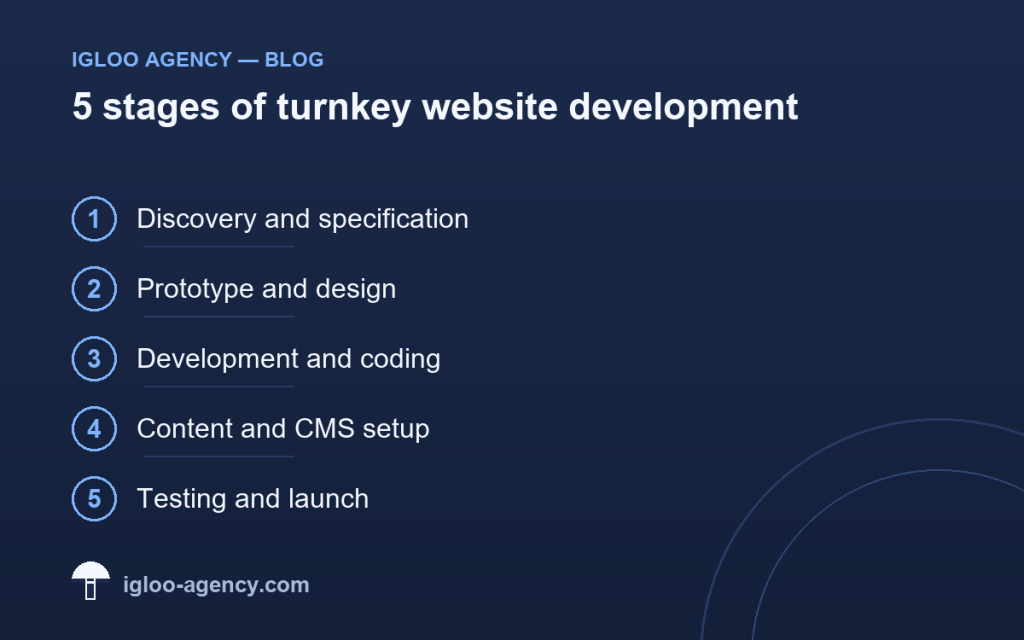
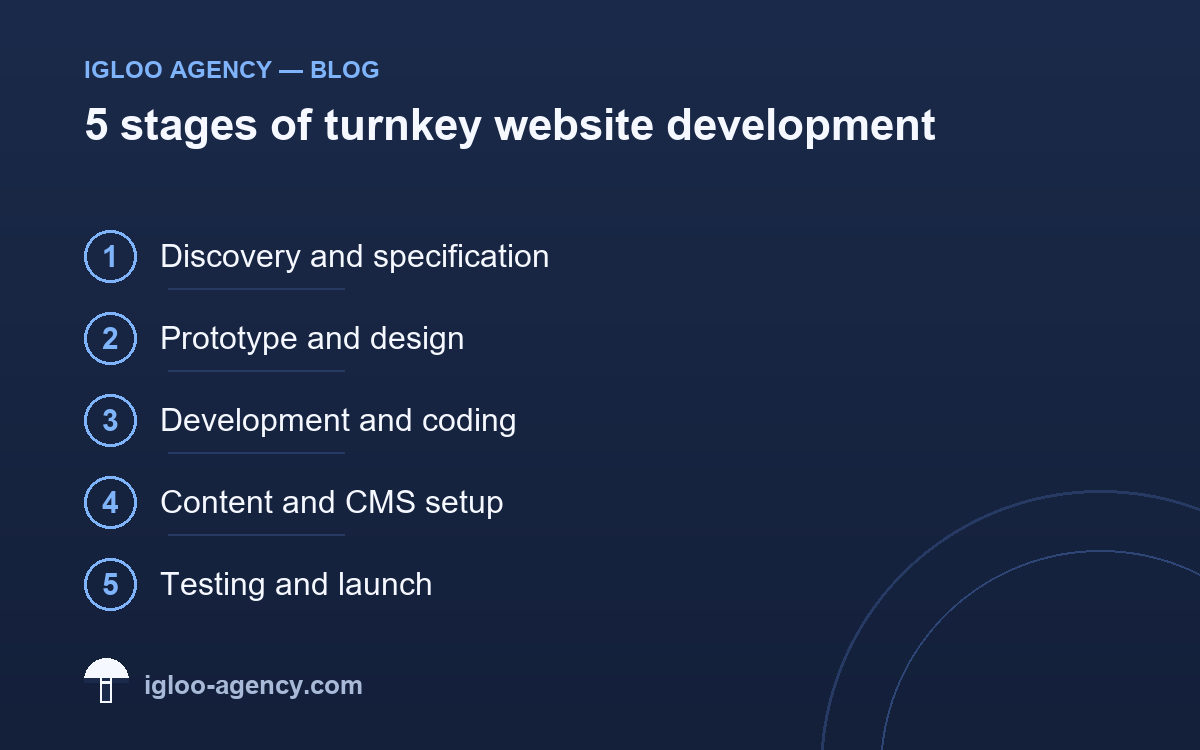
Website development combines discovery, design, engineering, content and testing. This guide explains the stages and questions to agree with a contractor before starting.
Most of our clients come to us with the same story: first they hired a “friend who knows websites”, then searched for a designer, then for a developer — and six months later there was still no website. Turnkey website development exists to prevent exactly this: one team, one point of responsibility, one contract.
What turnkey website development includes
The full cycle covers everything a website needs before it can honestly be called ready. For us at Igloo Agency, turnkey website development starts with this checklist, which a contractor should walk through with you before any contract is signed:
- discovery and prototyping — page structure, user journeys, the technical specification;
- design — custom layouts or a tailored premium theme that matches your brand;
- development — responsive markup, CMS, integrations, performance;
- content — copy, photography, translations for every language version;
- SEO foundation — metadata, structured data, sitemap, robots.txt;
- testing and launch — checks across 20+ devices and browsers, analytics setup;
- post-launch care — updates, backups, uptime monitoring.
Stages of turnkey website development: from idea to launch
A typical project takes 4 to 12 weeks depending on scope. At Igloo Agency every stage has a concrete deliverable, so the client sees progress instead of promises:
- Brief and discovery — 3–7 days: goals, audience, competitors, structure.
- Prototype — 5–10 days: wireframes of every page, approved by you.
- Design concept and layouts — 7–15 days: visuals for all key pages.
- Development — 10–30 days: responsive templates, CMS, forms, payments, integrations.
- Content population — in parallel with development: copy, images, translations.
- Testing and acceptance — 3–7 days: bugs, speed, SEO checks, team training.
- Launch and handover — 1–2 days: domain, hosting, analytics, documentation.
For a detailed breakdown of costs by stage, read our article on how much a website costs — it is worth reading before you set a budget.
How much turnkey website development costs
The figures below are hypothetical budgeting examples, not verified market averages or Igloo Agency rates. They are not an offer; request an estimate based on your requirements.
| Website type | Timeline | Price (EUR) |
|---|---|---|
| Small business site (5–10 pages) | 3–5 weeks | 1,200–3,000 |
| Corporate website (10–30 pages) | 6–10 weeks | 3,000–9,000 |
| E-commerce store | 8–14 weeks | 5,000–20,000+ |
| Web platform / SaaS | 3–6 months | from 15,000 |
These figures are illustrative: the final price of turnkey website development depends on the number of custom templates, integrations and language versions. A suspiciously cheap quote is a risk signal — more on that below.
Which technologies to choose
The stack shapes speed, maintenance costs and room to grow. Across Igloo Agency projects we apply three approaches depending on the task:
- WordPress — the best fit for corporate sites and smaller stores: fast launch, a huge ecosystem, easy administration for your team.
- WooCommerce and specialised e-commerce builds — for catalogues up to 50,000 SKUs, complex pricing and accounting integrations.
- Custom development on modern frameworks — for platforms and SaaS products where template CMSs become a ceiling.
Scope, deliverables, review points, budget and timelines are agreed for each project before work begins.
The choice of stack depends on the task: website development services on WordPress, e-commerce development on WooCommerce, or a custom platform — in each case the terms are fixed before kick-off. If you are unsure where to start, the checklist below will help you brief vendors properly and order a website without budget surprises.
How to choose a contractor and avoid costly mistakes
The market is saturated with offers, and price is a poor compass. These are the criteria that actually work — we go through the same checks in tenders for clients like Kyivstar and MEGOGO:
How do you vet a portfolio?
Open 3–5 websites from the portfolio on your phone. If they are slow, broken or missing HTTPS, that is your future result. Asking for cases with numbers (conversion, traffic) filters out half of the “studios” immediately.
What should the contract include?
Scope, deliverables, review points, budget and timelines are agreed for each project before work begins.
Why do an agency’s own products matter?
An agency that builds its own digital products (like our ad dashboard or SEO service) understands product thinking better than pure executors. You notice it in the details: event tracking, speed, the structure of lead capture.
Common mistakes when ordering a website
- Starting with design instead of discovery — a beautiful site without structure does not sell.
- Cutting corners on content — empty pages with boilerplate text kill both SEO and conversions.
- Treating SEO as an afterthought — retrofitting it later costs more than building it in.
- Ignoring the mobile version — over 60% of B2B website traffic is now mobile.
- Not asking about maintenance upfront — a site without a support plan becomes slow and vulnerable within a year.
After launch, a website needs continuous seo promotion — without it, even a perfectly built site stays invisible. And if you plan several language versions, read our guide on multilingual websites — it covers hreflang and locale structure.
Inside Igloo Agency: how we deliver turnkey website development
Scope, deliverables, review points, budget and timelines are agreed for each project before work begins.
Website launch readiness checklist
Scope, deliverables, review points, budget and timelines are agreed for each project before work begins.
- Speed: LCP under 2.5 seconds on mobile 4G.
- Responsiveness: all key pages checked on 6+ screen sizes.
- HTTPS and redirects: no mixed content, no www/non-www duplicates.
- Forms: enquiries reach email and CRM, a test enquiry has been sent.
- Analytics: goal events configured, data arriving in real time.
- SEO basics: metadata, structured data, sitemap.xml and robots.txt in place.
- Backups and access: backups scheduled, credentials handed to the owner.
This checklist is the minimum any contractor should cover. If these items are missing from a proposal, the “who will handle this” question should be asked before signing, not after.
FAQ: common questions about turnkey website development
How long does turnkey website development take?
From 3 weeks for a small business site to 6 months for a platform. Real timelines are set by the prototype: once it is approved, deadlines are fixed in the contract with responsibilities on both sides.
Can a website be built cheaper than your table suggests?
The figures below are hypothetical budgeting examples, not verified market averages or Igloo Agency rates. They are not an offer; request an estimate based on your requirements.
Who owns the website after launch?
You do. Domain, hosting, analytics accounts and the CMS are registered to your company, and source files are handed over with a signed acceptance report. This is a core principle at Igloo Agency: a client is never held hostage by a vendor.
Is SEO included in turnkey website development?
The SEO foundation — structure, metadata, speed, structured data — yes, it is included. Ongoing promotion is a separate service that starts after launch. Details are in our article on seo promotion.
What happens to the website a year after launch?
With a support plan — updates, backups, monitoring and evolution. Without one, vulnerabilities, outdated plugins and slowing performance pile up within a year. That is why we recommend planning a maintenance subscription from day one.
Conclusion
Turnkey website development is not buying a picture — it is investing in a lead-generation channel. The right contractor fixes the scope of work, shows cases with numbers and hands you control of the asset. The wrong one sells a template at project prices. So choose your team with the same care you would choose an accountant or a lawyer.
Tell us about your project and requirements. We can discuss the scope and prepare a proposal; cost and timing are agreed individually.
Planning a mobile product? Read our guide to mobile app development: costs, stages and timelines from idea to release.